When most people think about angels, they picture beautiful figures dressed in white robes with soft feathered wings floating peacefully among the clouds. Others imagine tiny cherubs decorating greeting cards or paintings. While these images are common in art and popular culture, they are very different from the angels described in the Bible.
Scripture presents angels as powerful spiritual beings created by God to accomplish His purposes. Some serve as heavenly messengers, others worship continually around God’s throne, and many carry out divine judgment or protect God’s people according to His will. Their appearances are often so awe-inspiring that the first words they speak are, “Do not be afraid.”
Understanding biblically accurate angels helps us appreciate God’s majesty and the unseen spiritual realm that exists beyond our physical world. Rather than relying on tradition or artistic imagination, this guide explores what the Bible actually teaches about angels and their unique role in God’s plan.
The Biblical Foundation of Angels
The Bible never attempts to prove that angels exist. Instead, it introduces them naturally as part of God’s creation. From Genesis to Revelation, angels appear at significant moments throughout biblical history, carrying messages, protecting believers, executing judgment, and worshiping God.
They are not fictional characters or symbolic ideas. They are real spiritual beings created by God before humanity existed.
What Scripture Reveals About Angels
The Bible consistently describes angels as created beings who exist to glorify God and carry out His commands. Hebrews 1:14 explains their primary purpose:
“Are not all angels ministering spirits sent forth to minister for them who shall be heirs of salvation?” — Hebrews 1:14 (KJV)
This single verse summarizes much of what Scripture teaches. Angels are servants of God. They are powerful, intelligent, and holy, but they are never equal to God Himself.
Throughout Scripture we discover several important truths about angels:
- They were created before the earth was fully formed (Job 38:4–7).
- They are countless in number (Hebrews 12:22).
- They possess great wisdom and strength.
- They obey God’s commands immediately.
- They never replace God’s authority.
- They rejoice when sinners repent (Luke 15:10).
- They continually worship God’s holiness.
Unlike humans, angels do not experience death in the same way. Jesus taught:
“Neither can they die any more: for they are equal unto the angels.” — Luke 20:36 (KJV)
Although angels possess incredible abilities, they are not all-knowing or all-powerful. Only God possesses those attributes. Angels remain completely dependent upon their Creator and exist solely for His glory.
The Etymology and Meaning of ‘Angel’
Understanding the word angel provides insight into their purpose.
The Hebrew word mal’akh literally means messenger or one who is sent. In the New Testament, the Greek word angelos carries the same meaning.
This is important because Scripture defines angels more by what they do than by what they look like.
Whenever God wanted to communicate an important message, protect His people, or accomplish His will on earth, He often sent one of His heavenly messengers.
For example:
- Gabriel announced the births of John the Baptist and Jesus.
- Angels warned Joseph to flee into Egypt.
- Angels delivered Peter from prison.
- Angels guided Philip toward the Ethiopian official.
Their identity is connected to their mission. They are God’s servants, faithfully carrying His messages and accomplishing His purposes.
This understanding reminds believers that every angel exists to magnify God not themselves.
Also read: Biblically Accurate Lucifer: Unveiling the Truth Behind His Story and Misconceptions
Angels as Spiritual Beings and Ministering Spirits
Although angels sometimes appeared physically in Scripture, they are primarily spiritual beings.
They belong to the heavenly realm while still interacting with the physical world whenever God commands.
Because they are spiritual beings, angels can accomplish tasks beyond human ability.
Throughout the Bible angels:
- Shut the mouths of lions (Daniel 6:22)
- Rolled away the stone from Jesus’ tomb (Matthew 28:2)
- Opened prison doors (Acts 12:7)
- Protected God’s servants
- Defeated armies
- Delivered divine messages
Psalm 103 beautifully describes their strength:
“Bless the LORD, ye his angels, that excel in strength, that do his commandments, hearkening unto the voice of his word.” — Psalm 103:20 (KJV)
Yet despite their immense power, angels never seek worship.
When John attempted to worship an angel in Revelation, the angel immediately corrected him:
“See thou do it not… worship God.” — Revelation 22:9 (KJV)
This demonstrates the humility of faithful angels. Their purpose is always to direct attention toward God rather than themselves.
Contrasting Biblical Angels with Popular Culture
Modern culture has dramatically reshaped the image of angels.
Movies, television shows, artwork, and greeting cards often portray them as gentle humans with white robes, glowing halos, and soft feathered wings. While these images may be comforting, they rarely reflect what Scripture actually describes.
Biblical angels are majestic, powerful, and sometimes even frightening because they reflect the glory of God’s heavenly presence.
Understanding the difference helps us separate tradition from biblical truth.
How Modern Media Misrepresents Angels
Over the centuries, artists and storytellers have created an image of angels that focuses on beauty rather than biblical accuracy.
Today’s popular culture often portrays angels as:
- Young women with long flowing hair
- Gentle children with tiny wings
- Romantic guardian figures
- Harp-playing musicians floating on clouds
- Friendly supernatural helpers
The Bible paints a much different picture.
Some angels appear as ordinary men.
Others possess multiple wings.
Cherubim have multiple faces.
Seraphim have six wings.
The living creatures in Ezekiel’s vision appear unlike anything found in nature.
Rather than inspiring comfort, biblical angelic appearances often overwhelmed those who witnessed them.
Daniel wrote:
“There remained no strength in me.” — Daniel 10:8 (KJV)
The prophet collapsed because of the overwhelming glory of the heavenly messenger standing before him.
Hollywood often emphasizes emotional comfort, but Scripture emphasizes God’s holiness and power.
The biblical picture is far more awe-inspiring than anything popular culture has imagined.
Why Angels Say “Fear Not” in Scripture
One fascinating detail appears repeatedly whenever angels visit human beings.
Their first words are often:
“Fear not.”
Why?
Because those who encountered angels were terrified.
When Gabriel appeared to Mary, he said:
“Fear not, Mary: for thou hast found favour with God.” — Luke 1:30 (KJV)
When angels appeared to the shepherds announcing Jesus’ birth, they declared:
“Fear not: for, behold, I bring you good tidings of great joy.” — Luke 2:10 (KJV)
The shepherds were not simply surprised.
Luke records:
“They were sore afraid.” — Luke 2:9 (KJV)
The brightness of God’s glory surrounding these heavenly beings produced overwhelming fear.
Throughout Scripture, people often responded to angelic appearances by:
- Falling to the ground
- Trembling
- Covering their faces
- Thinking they were about to die
- Becoming speechless
This reaction reminds us that angels belong to the holy presence of God. Even though they are created beings, they reflect enough of His glory to overwhelm sinful humanity.
The repeated phrase “Fear not” is not merely a comforting greeting—it is a necessary reassurance that God has sent His messenger in peace rather than judgment.
Archangels: The Named Messengers of Heaven
Among the countless angels created by God, the Bible identifies only a few by name. This is significant because Scripture places the focus on God rather than encouraging people to become fascinated with angels themselves. The named angels we encounter each have a unique assignment that advances God’s plan of redemption.
These heavenly messengers are never portrayed as independent beings acting on their own authority. Every mission they undertake is directed by God. Whether delivering life-changing announcements, protecting God’s people, or battling spiritual forces of evil, their work always reflects God’s sovereignty.
Michael: The Warrior Prince
Michael is the only angel explicitly called an archangel in the Bible (Jude 1:9). His name means “Who is like God?”—a rhetorical question that reminds all creation that no one can compare with the Lord.
Unlike Gabriel, whose ministry centers on delivering messages, Michael is consistently portrayed as a warrior. He defends God’s people and leads heavenly armies against Satan and the forces of darkness.
Daniel introduces Michael as Israel’s protector:
“Michael, one of the chief princes, came to help me.” — Daniel 10:13 (KJV)
Later Daniel records:
“At that time shall Michael stand up, the great prince which standeth for the children of thy people.” — Daniel 12:1 (KJV)
Michael’s ministry reaches its climax in the Book of Revelation, where he leads heaven’s armies into battle.
“And there was war in heaven: Michael and his angels fought against the dragon.” — Revelation 12:7 (KJV)
The dragon, identified as Satan, is defeated and cast out of heaven.
Another fascinating event involving Michael appears in Jude:
“Yet Michael the archangel, when contending with the devil he disputed about the body of Moses, durst not bring against him a railing accusation, but said, The Lord rebuke thee.” — Jude 1:9 (KJV)
Even Michael, despite his authority, depended completely upon God’s power rather than his own. His humility demonstrates that every faithful angel submits entirely to God’s authority.
Michael reminds believers that spiritual warfare is real, but God’s power is always greater than the forces of evil.
Gabriel: God’s Chief Herald
If Michael represents God’s heavenly warrior, Gabriel represents His faithful messenger.
The name Gabriel means “God is my strength.”
Throughout Scripture, Gabriel appears whenever God is about to reveal an important moment in salvation history.
His first recorded appearance is in the Book of Daniel, where he helps the prophet understand difficult visions concerning future events.
“Gabriel, make this man to understand the vision.” — Daniel 8:16 (KJV)
Centuries later, Gabriel appeared to Zechariah while he served in the temple.
He announced that Zechariah and Elizabeth would miraculously have a son—John the Baptist—who would prepare the way for the Messiah.
Gabriel introduced himself by saying:
“I am Gabriel, that stand in the presence of God.” — Luke 1:19 (KJV)
Only a few months later, Gabriel visited a young woman named Mary with perhaps the greatest announcement ever delivered.
“And the angel came in unto her, and said… thou shalt conceive in thy womb, and bring forth a son, and shalt call his name JESUS.” — Luke 1:28–31 (KJV)
This message changed human history forever.
Gabriel’s ministry teaches us that God’s promises unfold according to His perfect timing. Even when centuries pass between prophecies and their fulfillment, God faithfully accomplishes His Word.
The Unique Role of Named Angels
One interesting question many readers ask is why the Bible names so few angels.
Scripture contains countless references to angels, yet only Michael and Gabriel are clearly identified by name in the Protestant canon.
This limitation appears intentional.
Rather than encouraging believers to seek relationships with angels, the Bible consistently directs worship toward God alone.
Paul even warns Christians:
“Let no man beguile you… in a voluntary humility and worshipping of angels.” — Colossians 2:18 (KJV)
Faithful angels never desire worship.
Whenever humans attempted to worship them, they immediately redirected that worship toward God.
Their identities are important only because of the missions God entrusted to them.
Michael reveals God’s victory over evil.
Gabriel proclaims God’s plan of salvation.
Together, they remind us that heaven is actively involved in God’s redemptive work on earth.
Seraphim: The Fiery Worshipers at God’s Throne
Among all the heavenly beings described in Scripture, few are as awe-inspiring as the seraphim.
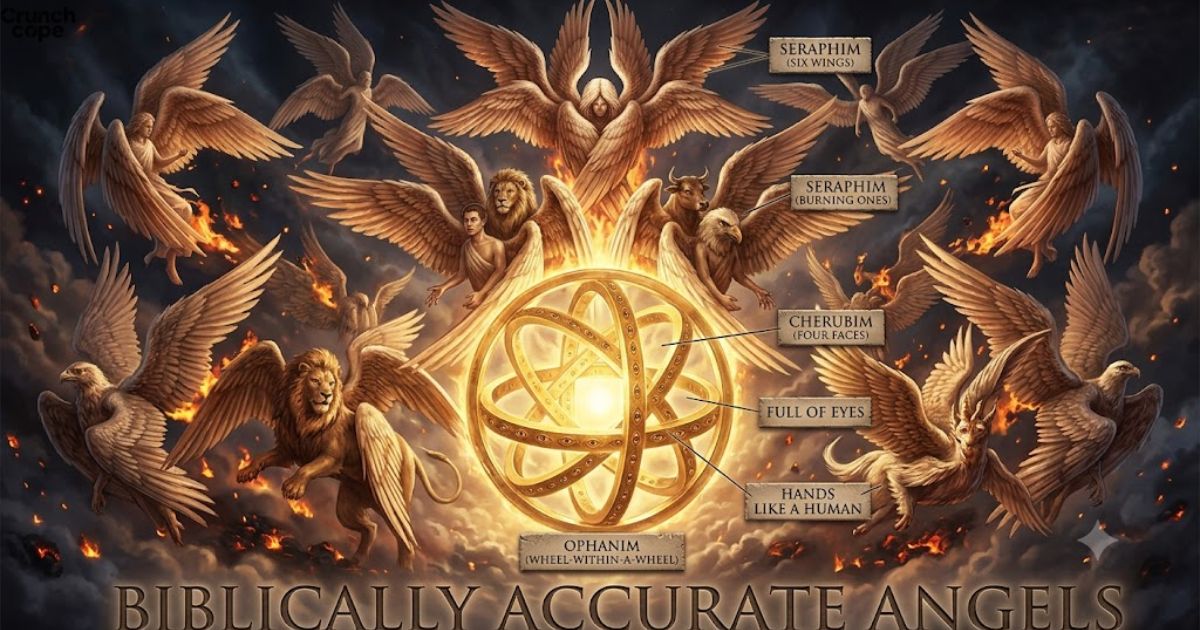
These magnificent creatures appear in Isaiah’s vision of God’s heavenly throne room. Their name comes from the Hebrew word meaning “burning ones,” reflecting both their radiant appearance and their association with God’s holiness.
Unlike angels sent to earth as messengers, the seraphim remain continually in God’s presence, worshiping Him without ceasing.
Isaiah describes the breathtaking scene:
“I saw also the Lord sitting upon a throne, high and lifted up.” — Isaiah 6:1 (KJV)
Around that throne stood the seraphim.
The Six Wings and Their Symbolic Meaning
Isaiah gives one of the Bible’s most detailed descriptions of heavenly beings.
“Above it stood the seraphims: each one had six wings.” — Isaiah 6:2 (KJV)
Every pair of wings had a specific purpose.
Two wings covered their faces.
Even these holy beings could not fully gaze upon God’s overwhelming glory.
Two wings covered their feet.
This symbolized humility and reverence before the Creator.
Two wings allowed them to fly.
These wings demonstrated their readiness to obey God instantly.
This beautiful imagery teaches an important spiritual lesson.
True worship involves humility, reverence, and willing obedience.
The seraphim model perfect devotion to God.
The Threefold Holy Proclamation
Perhaps the most famous words spoken by angels appear in Isaiah chapter six.
The seraphim continually cry:
“Holy, holy, holy, is the LORD of hosts: the whole earth is full of his glory.” — Isaiah 6:3 (KJV)
Notice that God’s holiness is repeated three times.
In Hebrew writing, repetition emphasizes greatness.
God is not simply holy.
He is perfectly, eternally, infinitely holy.
As the seraphim worship, Isaiah records that the temple shakes and fills with smoke.
The overwhelming glory of God’s presence causes the prophet to recognize his own sinfulness.
He cries:
“Woe is me! for I am undone.” — Isaiah 6:5 (KJV)
The holiness of God exposes the impurity of every human heart.
Seraphim’s Role in Purification
The seraphim do more than worship.
They also participate in God’s work of cleansing.
Isaiah describes one seraph taking a live coal from the heavenly altar and touching it to his lips.
The angel declares:
“Lo, this hath touched thy lips; and thine iniquity is taken away, and thy sin purged.” — Isaiah 6:7 (KJV)
Only after this cleansing is Isaiah prepared to receive God’s calling.
This passage beautifully illustrates an important biblical truth.
Before anyone can faithfully serve God, they must first experience His forgiveness and purification.
The burning coal symbolizes God’s cleansing grace.
Today believers experience this cleansing through the sacrifice of Jesus Christ, whose blood removes sin completely.
Cherubim: The Multi-Faced Guardians of Holy Places
Few biblical beings have been more misunderstood than the cherubim.
Popular culture often portrays cherubs as tiny winged babies decorating paintings or greeting cards.
The Bible describes something entirely different.
Cherubim are majestic heavenly guardians who protect the holiness of God.
They appear throughout Scripture wherever God’s sacred presence is revealed.
Cherubim Guarding the Garden of Eden
The first appearance of cherubim occurs immediately after Adam and Eve are expelled from Eden.
Genesis records:
“He placed at the east of the garden of Eden Cherubims, and a flaming sword… to keep the way of the tree of life.” — Genesis 3:24 (KJV)
These mighty guardians prevented sinful humanity from returning to the Tree of Life.
Their presence reminds us that sin separates people from God’s holy presence.
Only God’s provision for redemption can restore that relationship.
The Four Faces and Their Significance
Ezekiel provides one of the Bible’s most fascinating descriptions of cherubim.
Each possessed four faces:
- The face of a man
- The face of a lion
- The face of an ox
- The face of an eagle
“Every one had four faces.” — Ezekiel 1:6 (KJV)
Many Bible scholars understand these faces as representing different aspects of God’s creation.
- Lion — Majesty and kingship
- Ox — Strength and faithful service
- Man — Intelligence and relationship
- Eagle — Vision, swiftness, and heavenly authority
Together they reflect God’s sovereign rule over all creation.
Cherubim on the Ark of the Covenant
God instructed Moses to include golden cherubim on the Ark of the Covenant.
Exodus records:
“And thou shalt make two cherubims of gold.” — Exodus 25:18 (KJV)
Their wings stretched over the mercy seat, where God’s presence would dwell among His people.
This location emphasized two important truths.
God is perfectly holy.
Yet through atonement, sinful people may approach Him.
The cherubim guarded God’s holiness while the mercy seat proclaimed His grace.
Together they beautifully pointed forward to Jesus Christ, who would become the perfect sacrifice for sin.
Eyes Symbolizing God’s Omniscience
Ezekiel also describes cherubim as being covered with eyes.
“Their whole body… and the wheels, were full of eyes round about.” — Ezekiel 10:12 (KJV)
These eyes symbolize God’s perfect knowledge.
Nothing escapes His attention.
Every action, every thought, and every hidden motive is fully known to Him.
Rather than frightening believers, this truth offers comfort.
The God who watches over His people never misses a single detail of their lives.
His knowledge is complete, His wisdom is perfect, and His judgments are always righteous.
Living Creatures and Ophanim: The Most Mysterious Angels
Among all the heavenly beings described in Scripture, none are more mysterious than the living creatures and the ophanim, often called the “wheel angels.” Their appearance is so extraordinary that even the prophet Ezekiel struggled to describe what he saw. His vision reveals the majesty of God’s throne and reminds us that the spiritual realm is far more glorious and complex than our human imagination can fully grasp.
Rather than focusing on frightening imagery, these visions emphasize God’s sovereignty, wisdom, and glory. Every detail points back to the greatness of the Creator rather than the creatures themselves.
Ezekiel’s Vision of the Living Creatures
The prophet Ezekiel received an astonishing vision while living in exile by the River Chebar.
He writes:
“I looked, and, behold, a whirlwind came out of the north, a great cloud, and a fire infolding itself.” — Ezekiel 1:4 (KJV)
From within this brilliant cloud emerged four living creatures unlike anything Ezekiel had ever seen.
He describes them as having:
- Four faces
- Four wings
- Hands beneath their wings
- Legs that shone like polished bronze
- A glowing appearance like burning coals
- Lightning flashing around them
“Their appearance was like burning coals of fire.” — Ezekiel 1:13 (KJV)
Everything about these beings reflected the holiness and power of God.
Later in Ezekiel chapter 10, the prophet identifies these living creatures as cherubim.
This teaches us that heavenly beings may appear differently depending on the purpose of the vision. Human language is often insufficient to describe the realities of heaven.
The living creatures constantly moved in perfect harmony with God’s Spirit. They never acted independently or according to their own desires. Their complete obedience demonstrates the perfect order of God’s heavenly kingdom.
The Wheel Angels: Ophanim Explained
Beside each living creature Ezekiel noticed an enormous wheel.
These were unlike ordinary wheels.
Each appeared to be “a wheel in the middle of a wheel.”
“Their appearance and their work was as it were a wheel in the middle of a wheel.” — Ezekiel 1:16 (KJV)
The Hebrew word Ophanim simply means “wheels.”
Although the Bible never specifically calls them a separate class of angels, many Jewish traditions refer to these heavenly beings as Ophanim because of their unique appearance.
The intersecting wheels symbolized that God’s throne can move in every direction without turning.
Unlike earthly rulers who are limited by geography, God’s reign extends everywhere simultaneously.
Nothing can prevent Him from accomplishing His purposes.
Every movement of these wheels reflected perfect wisdom, perfect timing, and complete authority.
Wheels Within Wheels Covered With Eyes
One of the most striking details in Ezekiel’s vision is the countless eyes covering the wheels.
Scripture says:
“Their rings were full of eyes round about them four.” — Ezekiel 1:18 (KJV)
To modern readers this image may seem unusual, but its symbolism is powerful.
The eyes represent God’s perfect knowledge.
Nothing in heaven or on earth escapes His attention.
He sees:
- Every nation
- Every kingdom
- Every heart
- Every secret thought
- Every act of obedience
- Every injustice
Unlike human leaders who possess limited understanding, God’s knowledge is complete.
The wheels also remind us that God is always active.
His plans never stop moving forward.
Even when circumstances seem confusing, the Lord remains fully in control of history.
For believers, this truth brings tremendous comfort.
Our lives are never outside God’s watchful care.
The Relationship Between Living Creatures and Cherubim
Some readers wonder whether the living creatures and cherubim are different beings.
Ezekiel answers this question himself.
After describing another heavenly vision, he writes:
“I knew that they were the cherubims.” — Ezekiel 10:20 (KJV)
This statement connects the magnificent creatures of chapter one with the cherubim surrounding God’s throne.
The Book of Revelation also describes four living creatures worshiping continually before God.
John writes:
“They rest not day and night, saying, Holy, holy, holy, Lord God Almighty.” — Revelation 4:8 (KJV)
Although John’s description differs slightly from Ezekiel’s, both visions emphasize the same truth.
The highest purpose of every heavenly being is to glorify God.
Whether guarding His holiness, carrying His throne, or proclaiming His greatness, all of heaven exists for His glory.
General Angels: The Messengers Throughout Scripture
While special heavenly beings such as seraphim and cherubim receive remarkable descriptions, the majority of angels mentioned throughout Scripture simply serve as God’s faithful messengers.
These angels appear repeatedly throughout biblical history.
They comfort believers.
They protect God’s people.
They deliver important messages.
They carry out God’s judgments.
Their ministry demonstrates God’s ongoing care for His creation.
Angels Appearing in Human Form
One surprising fact about angels is that they sometimes appeared as ordinary people.
In several biblical accounts, individuals spoke with angels before realizing who they truly were.
The writer of Hebrews reminds believers:
“Be not forgetful to entertain strangers: for thereby some have entertained angels unawares.” — Hebrews 13:2 (KJV)
One famous example occurs when Abraham welcomed three visitors near the oaks of Mamre (Genesis 18).
What seemed like ordinary travelers were actually heavenly messengers sent by God.
Lot also welcomed two angels into his home before the destruction of Sodom.
These encounters reveal that angels can appear in forms that people easily recognize.
Their purpose is never to draw attention to themselves but to accomplish God’s mission.
Whenever they reveal their heavenly glory, however, the reaction is very different.
People often fall to the ground in fear because of the overwhelming presence of God’s holiness reflected through these heavenly servants.
The Mighty Acts Angels Perform
Throughout Scripture, angels accomplish extraordinary works that no human being could perform alone.
Some of the most remarkable examples include:
- Closing the mouths of hungry lions for Daniel.
- Freeing Peter from prison.
- Destroying the Assyrian army.
- Announcing miraculous births.
- Protecting God’s servants.
- Guiding missionaries.
- Strengthening believers during difficult times.
Daniel testified:
“My God hath sent his angel, and hath shut the lions’ mouths.” — Daniel 6:22 (KJV)
Peter also experienced miraculous deliverance.
“The angel of the Lord came upon him… and his chains fell off from his hands.” — Acts 12:7 (KJV)
These miracles remind believers that God often works through unseen spiritual servants to accomplish His purposes.
Although we may not always recognize their activity, Scripture assures us that God’s angels continue serving according to His will.
Angels Holding Swords as Warriors
The Bible frequently portrays angels as mighty warriors rather than gentle figures.
One memorable example occurs when Balaam’s donkey saw an angel standing in the road.
“The angel of the LORD standing in the way, and his sword drawn in his hand.” — Numbers 22:31 (KJV)
Joshua also encountered a heavenly commander before the battle of Jericho.
“As captain of the host of the LORD am I now come.” — Joshua 5:14 (KJV)
These passages remind us that angels participate in God’s spiritual warfare.
They defend God’s people.
They execute His judgments.
They fight against evil according to His commands.
Their strength demonstrates the overwhelming power available to accomplish God’s purposes.
Angels in the Life and Ministry of Christ
No human life was surrounded by greater angelic activity than the earthly ministry of Jesus Christ.
From His miraculous conception to His ascension into heaven, angels appeared repeatedly to announce, protect, strengthen, and testify concerning the Son of God.
Their ministry confirmed that Jesus was indeed the promised Messiah.
Angelic Announcements of Jesus’ Birth
The Christmas story is filled with angelic appearances.
Gabriel first announced John’s birth to Zechariah.
Soon afterward, he appeared to Mary.
“Thou shalt conceive in thy womb, and bring forth a son, and shalt call his name JESUS.” — Luke 1:31 (KJV)
Joseph also received guidance through an angel in a dream.
The angel instructed him not to fear taking Mary as his wife because her child had been conceived by the Holy Spirit.
Later, another angel warned Joseph to flee into Egypt to protect Jesus from King Herod.
Perhaps the most joyful angelic appearance occurred outside Bethlehem.
“Suddenly there was with the angel a multitude of the heavenly host praising God.” — Luke 2:13 (KJV)
Their praise announced peace through the birth of the Savior.
Angels Ministering to Jesus During His Earthly Life
Even during His earthly ministry, angels cared for Jesus.
After His forty days of temptation in the wilderness, Scripture records:
“Then the devil leaveth him, and, behold, angels came and ministered unto him.” — Matthew 4:11 (KJV)
Later, as Jesus prayed in Gethsemane before His crucifixion:
“There appeared an angel unto him from heaven, strengthening him.” — Luke 22:43 (KJV)
These moments demonstrate Christ’s true humanity.
Although He was fully God, He willingly experienced human weakness and accepted the Father’s provision through angelic ministry.
Angels at the Resurrection and Ascension
The resurrection morning included another dramatic angelic appearance.
Matthew records:
“The angel of the Lord descended from heaven… and rolled back the stone.” — Matthew 28:2 (KJV)
The guards became terrified.
The women, however, received wonderful news.
“He is not here: for he is risen.” — Matthew 28:6 (KJV)
After Jesus ascended into heaven, two angels appeared to His disciples.
They declared:
“This same Jesus… shall so come in like manner as ye have seen him go into heaven.” — Acts 1:11 (KJV)
Their message reminds believers that the risen Christ will one day return.
Jesus’ Teaching About Angels and Judgment
Jesus spoke about angels more than many people realize.
He taught that angels rejoice whenever sinners repent.
“There is joy in the presence of the angels of God over one sinner that repenteth.” — Luke 15:10 (KJV)
He also explained their role in the final judgment.
“The Son of man shall send forth his angels, and they shall gather out of his kingdom all things that offend.” — Matthew 13:41 (KJV)
At Christ’s return, angels will separate the righteous from the wicked according to God’s perfect justice.
This truth reminds believers that history is moving toward God’s appointed conclusion, and His heavenly servants will faithfully accomplish every part of His plan.
Angelic Activity in Acts and the Early Church
After Jesus ascended into heaven, the ministry of angels did not end. In fact, the Book of Acts records several occasions where God used angels to strengthen believers, guide missionaries, rescue His servants, and execute His righteous judgment. Their ministry demonstrates that God continued to direct and protect the early Church as the gospel spread throughout the world.
Although angels played an important role, they never became the center of the Church’s message. The apostles always pointed people to Jesus Christ rather than encouraging fascination with heavenly beings. Angels simply carried out God’s instructions to accomplish His purposes.
Angels Guiding the Spread of the Gospel
One of the primary roles of angels in Acts was guiding believers toward opportunities to share the gospel.
A remarkable example is found in Philip’s ministry.
“And the angel of the Lord spake unto Philip, saying, Arise, and go toward the south.” — Acts 8:26 (KJV)
Philip obeyed without hesitation. On the road he met the Ethiopian eunuch, explained the Scriptures, and led him to faith in Jesus Christ. This encounter became one of the earliest examples of the gospel spreading beyond Israel.
Another important event involved Cornelius, a Roman centurion.
“He saw in a vision evidently an angel of God coming in to him.” — Acts 10:3 (KJV)
The angel instructed Cornelius to send for Peter. Through this meeting, God revealed that salvation through Christ was available to Gentiles as well as Jews. It marked a major turning point in the history of the Church.
Later, the Apostle Paul also experienced angelic encouragement during a violent storm at sea.
“There stood by me this night the angel of God, whose I am, and whom I serve.” — Acts 27:23 (KJV)
The angel assured Paul that everyone aboard the ship would survive because God still intended for Paul to stand before Caesar.
These accounts remind believers that God often directs His work through unseen means. While angels continue serving God’s purposes today, our faith rests in God’s guidance rather than seeking angelic experiences.
Angels Executing Divine Judgment
The Bible also shows angels carrying out God’s justice.
One of the clearest examples appears in Acts 12.
King Herod Agrippa accepted praise that belonged only to God.
Instead of giving glory to the Lord, he accepted the people’s declaration that he was a god.
Scripture records the immediate consequence:
“Immediately the angel of the Lord smote him, because he gave not God the glory.” — Acts 12:23 (KJV)
Herod died because of his pride and refusal to honor God.
This account serves as a sobering reminder that God alone deserves worship.
Angels never act according to personal emotion or revenge. Every act of judgment they perform comes directly from God’s righteous authority.
Throughout both the Old and New Testaments, angels demonstrate that God’s justice is perfect. His patience is great, but His holiness should never be ignored.
Paul’s Theological Insights About Angels
The Apostle Paul offered several important teachings that help believers maintain a balanced understanding of angels.
First, he emphasized that angels are part of God’s created order.
In describing Christ’s supremacy, Paul wrote:
“For by him were all things created… whether they be thrones, or dominions, or principalities, or powers.” — Colossians 1:16 (KJV)
This means even the highest-ranking angels were created through Jesus Christ and exist for His glory.
Paul also warned Christians against becoming overly fascinated with angels.
“Let no man beguile you… in worshipping of angels.” — Colossians 2:18 (KJV)
Some false teachers encouraged angel worship or claimed secret spiritual experiences involving angels. Paul rejected these practices because they shifted attention away from Christ.
Another remarkable statement appears in 1 Corinthians:
“Know ye not that we shall judge angels?” — 1 Corinthians 6:3 (KJV)
Although Paul does not fully explain this future role, it highlights the incredible position believers will share with Christ in His eternal kingdom.
Most importantly, Paul consistently taught that Jesus is greater than every angel.
No angel died for humanity.
No angel conquered death.
No angel sits at God’s right hand as Savior and King.
Only Jesus Christ holds that position.
Angels in the Book of Revelation
The Book of Revelation contains more references to angels than any other book of the Bible.
These heavenly beings announce God’s judgments, protect His servants, worship before His throne, and participate in the final victory over evil.
Revelation reveals angels as active participants in God’s plan for the end of history.
Seven Angels With Seven Trumpets
One of Revelation’s most dramatic scenes involves seven angels standing before God.
Each receives a trumpet.
As each trumpet sounds, a specific judgment falls upon the earth.
John writes:
“And I saw the seven angels which stood before God; and to them were given seven trumpets.” — Revelation 8:2 (KJV)
The trumpet judgments include:
- Hail and fire destroying vegetation.
- A blazing mountain falling into the sea.
- Rivers becoming bitter.
- Darkness covering part of the heavens.
- Demonic torment upon the earth.
- Massive armies bringing destruction.
- The announcement of Christ’s coming kingdom.
These judgments demonstrate God’s holiness and His authority over creation.
The angels simply carry out His commands with complete obedience.
Angels Pouring Out God’s Wrath
Later in Revelation, seven more angels receive bowls filled with God’s wrath.
John writes:
“Go your ways, and pour out the vials of the wrath of God upon the earth.” — Revelation 16:1 (KJV)
These judgments include:
- Painful sores
- Seas turning to blood
- Rivers becoming blood
- Scorching heat
- Darkness
- The drying of the Euphrates River
- A devastating earthquake
These passages remind readers that God’s judgment is never random.
Every action is perfectly just.
The angels faithfully carry out His righteous decisions without adding to or subtracting from His commands.
Michael’s War Against the Dragon
One of the most dramatic moments in Revelation describes a war in heaven.
“Michael and his angels fought against the dragon.” — Revelation 12:7 (KJV)
The dragon represents Satan.
Although Satan fiercely resists God’s kingdom, he is ultimately defeated.
John declares:
“Neither was their place found any more in heaven.” — Revelation 12:8 (KJV)
Michael’s victory demonstrates that evil can never overcome God’s authority.
The battle may be intense, but the outcome has already been determined.
Christ is victorious.
The Angel Binding Satan
Near the end of Revelation another powerful angel descends from heaven.
John records:
“And I saw an angel come down from heaven, having the key of the bottomless pit.” — Revelation 20:1 (KJV)
The angel seizes Satan, binds him with a great chain, and confines him to the abyss for one thousand years.
This remarkable event highlights God’s complete sovereignty.
Even Satan, the greatest enemy of God’s people, remains under God’s authority.
No force in creation can resist God’s ultimate plan.
The Biblical Truth About Guardian Angels
The idea that every person has a personal guardian angel has become extremely popular.
Many books, movies, and children’s stories teach this concept as unquestionable truth.
But what does the Bible actually say?
Scripture clearly teaches that angels protect and minister to God’s people.
However, it is less specific about whether each believer has one permanently assigned guardian angel.
What Scripture Actually Teaches About Personal Protection
One of the best-known passages about angelic protection comes from Psalm 91.
“For he shall give his angels charge over thee, to keep thee in all thy ways.” — Psalm 91:11 (KJV)
This promise assures believers that God uses His angels to protect those who trust Him.
Jesus also spoke about children, saying:
“Their angels do always behold the face of my Father.” — Matthew 18:10 (KJV)
This verse suggests that angels have a special ministry toward God’s children, although it does not clearly state that each individual has one permanently assigned angel.
The emphasis remains on God’s loving care rather than the identity of the angels themselves.
Believers place their confidence in the Lord, who sends His heavenly servants whenever He chooses.
Communal Versus Individual Angelic Ministry
The Bible often speaks about angels serving God’s people collectively.
Hebrews says:
“Are they not all ministering spirits, sent forth to minister for them who shall be heirs of salvation?” — Hebrews 1:14 (KJV)
Notice the plural language.
Angels minister to all believers according to God’s will.
Psalm 34 also declares:
“The angel of the LORD encampeth round about them that fear him, and delivereth them.” — Psalm 34:7 (KJV)
Rather than focusing on individual assignments, Scripture emphasizes God’s continual protection over His people as a whole.
The central truth is not how many angels surround us, but that God faithfully watches over His children.
Angels Assigned to Nations and Groups
The Bible does reveal that certain angels have responsibilities connected with nations or groups of people.
In Daniel, Michael is described as the protector of Israel.
“Michael your prince.” — Daniel 10:21 (KJV)
Daniel also mentions spiritual rulers associated with Persia and Greece, suggesting a spiritual dimension behind earthly kingdoms.
In Revelation, letters are addressed to the “angel” of each of the seven churches.
Whether these refer to heavenly beings or human messengers has been widely discussed, but the passages clearly emphasize God’s oversight of His people.
Together, these verses show that angelic ministry often extends beyond individuals to entire communities, churches, and nations.
God governs history through both visible and invisible means.
Satan’s Fall and the Origin of Fallen Angels
The Bible teaches that not every angel remained faithful to God. Before humanity’s story unfolded, a rebellion took place in the heavenly realm. Led by Satan, many angels chose pride over obedience and were cast out of God’s presence. These fallen angels became enemies of God’s kingdom and continue to oppose His purposes.
Understanding the origin of fallen angels helps us understand why spiritual warfare exists today. It also reminds us that evil was never created by God as an equal force. Instead, it entered creation through the rebellion of creatures who misused the freedom God had given them.
Although Satan and his followers remain active, Scripture consistently teaches that their defeat is certain because of Jesus Christ.
Satan as a Fallen Cherub
The Bible describes Satan’s original position using language that points beyond an earthly king.
In Ezekiel 28, God speaks of one who was once an “anointed cherub” serving in His presence.
“Thou art the anointed cherub that covereth; and I have set thee so.” — Ezekiel 28:14 (KJV)
Although this passage directly addresses the king of Tyre, many Bible scholars believe it also reflects Satan’s original fall because the description goes beyond any ordinary human ruler.
Scripture portrays Satan as:
- Beautiful in appearance.
- Full of wisdom.
- Created perfect by God.
- Occupying a privileged place near God’s throne.
Yet perfection did not guarantee faithfulness.
Instead of honoring the Creator, Satan desired God’s position for himself.
His fall serves as one of Scripture’s strongest warnings against pride.
No matter how gifted or privileged we become, our purpose is always to glorify God rather than ourselves.
The Meaning of ‘Satan’ and ‘Lucifer’
The name Satan comes from the Hebrew word meaning “adversary” or “accuser.”
This perfectly describes his ongoing work.
Throughout Scripture, Satan opposes God’s purposes and seeks to accuse God’s people.
The title devil means “slanderer.”
Jesus described him as:
“A liar, and the father of it.” — John 8:44 (KJV)
The name Lucifer appears in the King James Version of Isaiah 14:12:
“How art thou fallen from heaven, O Lucifer, son of the morning!” — Isaiah 14:12 (KJV)
The Hebrew expression refers to the “morning star” or “shining one.” While Isaiah is addressing the king of Babylon, many Christians understand this passage to echo Satan’s rebellion because of its vivid description of a glorious being brought low through pride.
Whatever title Scripture uses—Satan, devil, serpent, dragon, or adversary—the message remains the same.
He opposes God but is never equal to God.
His authority is temporary and limited.
Christ alone reigns forever.
Pride as the Root of Angelic Rebellion
The heart of Satan’s rebellion was pride.
Isaiah records five ambitious statements often associated with his fall:
- “I will ascend into heaven.”
- “I will exalt my throne.”
- “I will sit also upon the mount.”
- “I will ascend above the heights of the clouds.”
- “I will be like the most High.”
— Isaiah 14:13–14 (KJV)
Instead of worshiping God, Satan desired God’s position.
His ambition became his destruction.
Ezekiel explains:
“Thine heart was lifted up because of thy beauty.” — Ezekiel 28:17 (KJV)
Pride continues to be one of humanity’s greatest spiritual dangers.
The fall of Satan reminds believers that true greatness is found in humility and obedience to God.
Jesus Himself modeled this perfectly.
Though He possessed all authority, He humbled Himself and became obedient even to death on the cross (Philippians 2:5–11).
Other Fallen Angels: Demons and Spiritual Rebellion
Satan did not rebel alone.
The Bible teaches that many angels joined his rebellion.
These fallen angels, commonly called demons or unclean spirits in the New Testament, now oppose God’s kingdom and seek to deceive humanity.
Yet even these spiritual enemies remain subject to God’s authority.
They cannot act beyond the limits God permits.
Their ultimate judgment has already been determined.
The Sons of God in Genesis Six
One of the most discussed passages in the Bible appears in Genesis 6.
Scripture says:
“The sons of God saw the daughters of men that they were fair.” — Genesis 6:2 (KJV)
Who were these “sons of God”?
Several interpretations have been suggested throughout church history.
Some believe they were fallen angels.
Others understand them as the godly descendants of Seth who married unbelieving women from Cain’s family.
Because the passage does not fully explain every detail, faithful Christians have held different views.
However, the New Testament mentions angels who abandoned their proper position.
Jude writes:
“The angels which kept not their first estate… he hath reserved in everlasting chains.” — Jude 1:6 (KJV)
Peter similarly states:
“God spared not the angels that sinned.” — 2 Peter 2:4 (KJV)
Together, these passages affirm that some angels rebelled in especially serious ways and now await final judgment.
Angels Bound in Chains of Darkness
Unlike demons who continue their activity on earth, Scripture teaches that certain fallen angels are already imprisoned.
Peter explains:
“God spared not the angels that sinned, but cast them down to hell.” — 2 Peter 2:4 (KJV)
Jude describes them as being kept:
“In everlasting chains under darkness unto the judgment of the great day.” — Jude 1:6 (KJV)
These verses reveal God’s absolute authority.
Even the most powerful rebellious spirits cannot escape His judgment.
Their imprisonment reminds believers that evil will never triumph over God’s righteousness.
Justice may seem delayed from a human perspective, but God’s final judgment is certain.
Demons and Unclean Spirits in the New Testament
The earthly ministry of Jesus included many encounters with demons.
These unclean spirits recognized Jesus immediately.
One demon cried out:
“I know thee who thou art; the Holy One of God.” — Mark 1:24 (KJV)
Although demons possess supernatural knowledge, they cannot resist Christ’s authority.
With a single command, Jesus cast them out.
“Jesus rebuked him, saying, Hold thy peace, and come out of him.” — Mark 1:25 (KJV)
The Gospels reveal several important truths about demons.
They:
- Recognize Jesus as God’s Son.
- Fear God’s judgment.
- Seek to deceive people.
- Oppose God’s work.
- Cannot overcome Christ’s authority.
The Apostle Paul reminds believers that spiritual warfare continues today.
“For we wrestle not against flesh and blood, but against principalities, against powers.” — Ephesians 6:12 (KJV)
Thankfully, Christians do not fight alone.
God has provided spiritual armor, His Holy Spirit, His Word, and the victory of Christ.
Because Jesus conquered sin, death, and Satan through His resurrection, believers can stand confidently in His strength.
Summary: The Magnificent Reality of Biblical Angels
The Bible presents angels as far more than decorative figures or imaginary beings. They are powerful spiritual servants created by God to accomplish His perfect will. From Genesis to Revelation, angels appear at pivotal moments in salvation history—announcing God’s promises, protecting His people, worshiping before His throne, carrying out His judgments, and rejoicing over those who come to faith.
We have explored the remarkable diversity of heavenly beings described in Scripture. We met Michael, the mighty warrior who defends God’s people, and Gabriel, the faithful messenger who announced the births of John the Baptist and Jesus. We stood in awe with Isaiah as the seraphim cried, “Holy, holy, holy,” and witnessed the majestic cherubim guarding God’s holiness. We also considered Ezekiel’s extraordinary vision of the living creatures and the mysterious wheels covered with eyes, all pointing to God’s unmatched glory and sovereignty.
The Bible also reminds us that angels are not the focus of our worship. Their purpose is always to glorify God and direct people toward Him. Whenever humans attempted to worship angels, they refused that honor and pointed worship back to the Lord alone. This truth keeps our attention where it belongs—on Jesus Christ, who is greater than every angel because He alone is the eternal Son of God and the Savior of the world.
We also examined the sobering reality of fallen angels and Satan’s rebellion. Although evil is real, it is never outside God’s control. Satan is a defeated enemy whose final judgment is certain. Through Christ’s death and resurrection, believers have victory over sin, death, and the powers of darkness.
Studying biblically accurate angels ultimately leads us to a greater appreciation of God’s majesty. These mighty heavenly beings reveal His holiness, power, justice, mercy, and perfect order. They remind us that an unseen spiritual realm surrounds us and that God is continually working to accomplish His purposes.
As Hebrews encourages us, our confidence is not in angels themselves but in the God who commands them. They are His faithful servants, carrying out His will until the day when Christ returns in glory.
May our study of angels deepen our reverence for the Lord, strengthen our trust in His protection, and inspire us to join heaven’s eternal song:
“Holy, holy, holy, Lord God Almighty, which was, and is, and is to come.” — Revelation 4:8 (KJV)
When we understand the true nature of biblical angels, we gain a richer understanding of the greatness of the God they serve.

Amelia Mia is a passionate digital creator and the driving force behind a dynamic general-niche website that delivers diverse, engaging, and informative content. With a strong focus on quality and user value, Amelia curates topics that resonate with a broad audience, from technology and lifestyle to trending insights.